This work explores the deep mathematical connections between two seemingly different stochastic processes: the classical Bernoulli process illustrating the Law of Large Numbers and the security server model representing a biased random walk. It is shown that both models share a core dependence on binomial principles, exposing common structures across different areas of probability and combinatorics.
Analogies between two Applications of Bernoulli Processes: LLN vs. Security Model
Core Structural Similarities
Both models are fundamentally governed by the Law of Large Numbers (LLN), demonstrating how aggregate outcomes stabilize over many independent trials. Each process consists of repeated trials with two mutually exclusive outcomes (success/failure for LLN demonstration; secured/compromised for security model). The outcome of any individual trial is statistically independent from others, with constant probability governing each event. Both processes show how cumulative measures converge to theoretical expectations as the number of trials increases, providing concrete examples of probabilistic convergence.
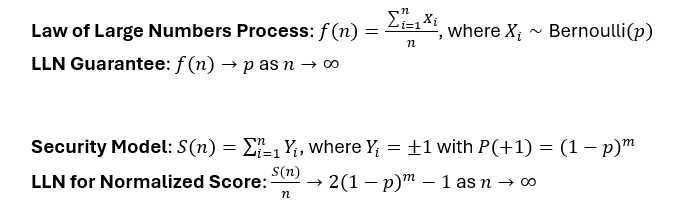
Mathematical Formulations
Convergence Patterns
Both models visually demonstrate the core principle of LLN:
- Initial Phase (Small n): High variability, wide dispersion of trajectories
- Intermediate Phase: Emerging convergence trends, reduced oscillations
- Final Phase (Large n): Stable convergence to theoretical values, minimal fluctuations
The security model extends the classical LLN demonstration by showing convergence to a derived theoretical value 2(1−p)m−1 rather than a direct input parameter, illustrating how LLN applies to transformed Bernoulli processes.
The security model can be expressed as a linear transformation of the LLN process:S(n)=2nf(n)−n, where f(n) follows the classical LLN with probability parameter (1−p)m. This reveals that both analyses are studying the same fundamental convergence phenomenon through different mathematical lenses.
Key Differences and Special Properties
Fundamental Probability Structure
- LLN / Bernoulli Process: The system’s behavior is governed by a single, fundamental probability parameter
p. - Security Model: The governing probability is a composite measure,
(1−p)m, which emerges from the interplay ofmindependent attackers.
Outcome Scaling and Measurement
- LLN / Bernoulli Process: Results are measured as relative frequencies, confined to the interval [0, 1].
- Security Model: Outcomes are expressed as cumulative scores, which can range across the interval [-n, n].
Observational Convergence Dynamics
LLN / Bernoulli Process: Trajectories show gradual convergence as the proportion of successes stabilizes.
Security Model: The discrete ±1 scoring creates more pronounced visual separation between paths, often giving the impression of sharper convergence, even though the underlying statistical convergence rate is similar.
Binomial Processes: A Unified View of LLN and Security Models
Binomial Coefficients and Pascal’s Triangle
Both processes inherently connect to binomial coefficients C(n,k):
- LLN Process: After
ntrials, the probability of exactlyksuccesses follows:P(k success) = C(n,k)*pk * (1-p)n-k. This binomial distribution governs the sampling variability that the LLN predicts will diminish as n increases. - Security Model (LLN Applied): After
nweeks, the probability of exactly k secure weeks is:P(k secure weeks) = C(n,k)*[(1-p)m]k *[1-(1-p)m]n-k. This represents the same binomial structure with a transformed probability parameter.
Pascal’s Triangle Connection: The coefficients C(n,k) present in both probability distributions align with the entries of Pascal’s Triangle. These combinatorial coefficients enumerate the distinct sequences in which k successes can occur across n trials, forming the essential counting mechanism that underpins the Law of Large Numbers demonstrations in both models.
Binomial Expansion: The Bridge Between Models
The security model’s weekly security probability, P(secure)=(1−p)m, can be expanded using the binomial theorem:

This expansion is crucial as it reveals the hidden Bernoulli process within the security model. It demonstrates that the probability of a secure week is the sum of probabilities over all possible outcomes of the m independent attacks. The term for k=0 represents the specific scenario where zero attackers succeed, which directly corresponds to a “success” in a Bernoulli trial with probability (1−p)m. Thus, the expansion mathematically exposes how the complex security scenario reduces to an effective Bernoulli process, bridging the two homework assignments.
Combinatorial and Sequence Connections
Fibonacci and Combinatorial Patterns
While the models do not generate classic sequences like the Fibonacci numbers, their underlying behavior is defined by recursive combinatorial principles. In the Bernoulli process, the number of potential sequences that lead to a specific number of successes is governed by combinatorial counting. Similarly, the security model’s random walk exhibits path-dependent behaviors, such as first-passage times, whose enumeration relates to other combinatorial sequences like the Catalan numbers.
Fundamental Inter-Model Connection
A profound link between the two frameworks is established through a direct linear transformation. The security score can be expressed precisely in terms of the count of Bernoulli successes:
Security Score = 2 × (Number of Secure Weeks) - n
This equation demonstrates that the security model is a linear rescaling of a Bernoulli process. This transformation maintains the core distributional shape of the binomial outcomes while translating them into a different notational framework of net scores.
Mathematical Properties and Relationships
Moment Generating Functions
The deep stochastic connection between the two models is captured by their Moment Generating Functions (MGFs), which characterize their entire probability distributions.
- LLN/ Bernoulli process: The MGF for the sum of successes is given by:
MGFLLN/Bernoulli(t) = (1-p + pet)n. - Security: The MGF for the cumulative security score S(n) takes the form:
MGFSecurity(t)= [(1-p)m et + (1-(1-p)m) e-t]n.
This structure confirms that the security model is probabilistically equivalent to a transformed Bernoulli process, where the effective probability of a “success” (an upward step of +1) is (1−p)m.
Central Limit Theorem Applications
The visual convergence observed in the simulations is formally described by the Central Limit Theorem (CLT), which specifies the asymptotic distribution of the outcomes.
- LLN / Bernoulli Process: The sample mean converges in distribution to a normal random variable.
- Security Model: The normalized security score exhibits analogous Gaussian convergence.

Conclusions
In conclusion, this comparative analysis reveals that the Law of Large Numbers simulation and the Server Security model, despite their different applied contexts, are two manifestations of the same fundamental stochastic principles. Both are fundamentally rooted in the Bernoulli process, demonstrating how aggregate stability emerges from individual randomness. In summary, the two models are mathematically unified through their shared binomial foundation. Both processes rely on the combinatorial principles of Pascal’s Triangle and demonstrate how the Law of Large Numbers produces stability from randomness. The security model is essentially a transformed Bernoulli process, connected by the linear relationship Security Score = 2K - n and the composite probability (1-p)m. A single, powerful conclusion emerges: the mathematics of the binomial distribution constitutes a universal framework for understanding random phenomena and their long-term behavior, from the most basic probabilistic experiments to sophisticated applied models.